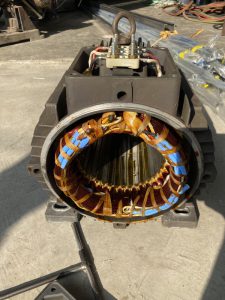
HMS – Haiphong Marine Services Company provides marine services, ship repair including rewind electric motor service for any type of motor for ships in Vietnam. Rewinding a motor involves dismantling it, removing the old winding coils, and replacing them with new ones.
HMS – Haiphong Marine Services Company provides the fastest and best electric motor rewinding service in Vietnam.
HMS – Haiphong Marine Services Company a leading provider of electric motor rewinding services in the marine sector. With many years of industry expertise, we specialize in the repair, refurbishment, and optimization of electric motors used in various maritime applications.
Our dedicated team of skilled professionals is committed to delivering superior quality and reliable solutions to meet the unique needs of our marine clients. Whether it’s propulsions systems, pumps, winches, or other vital machinery, we understand the critical role that electric motors play in maritime operations.
At HMS – Haiphong Marine Services Company, we combine technical excellence, state-of-the-art equipment, and meticulous attention to detail to ensure the highest standards of motor rewinding, extending their lifespan, enhancing efficiency, and minimizing downtime.
Partner with us for unmatched expertise and comprehensive motor rewinding services tailored to the demanding requirements of the marine service sector.
>>> About us <<<<
What do we do in electric motor rewinding service?
Electric motor rewinding is a complex process that involves several steps to repair or refurbish an electric motor. Here is a detailed breakdown of the typical steps involved in electric motor rewinding service:
– Motor Inspection: The motor is carefully examined to assess its overall condition and identify any visible damage or signs of wear. The inspector checks for issues such as burnt coils, damaged insulation, worn bearings, or other components that may require attention. The motor’s specifications, such as voltage, current, speed, and winding configuration, are recorded for reference during the rewinding process.
.jpg)
– Dismantling: The motor is disassembled, starting with the removal of the external casing and any other attached components. The rotor (the rotating part) and the stator (the stationary part) are separated, allowing access to the winding coils.
– Coil Removal: The old winding coils are carefully removed from the stator core and the rotor. This process may involve cutting and unwinding the old coils while taking care not to damage the stator or rotor.
.jpg)
– Coil Replacement: New winding coils are prepared, taking into account the motor’s specifications and winding configuration. The new coils are carefully wound around the stator core or inserted into the rotor slots. The coils are typically made of copper or aluminum wire with appropriate insulation.
– Varnishing and Drying: The newly wound coils are coated with insulating varnish to enhance their electrical insulation properties. The varnish is applied in multiple layers, allowing each layer to dry before applying the next. The varnishing process helps protect the winding coils from moisture, contaminants, and electrical shorts.
– Reassembly: After the varnish has dried, the motor components are reassembled. The rotor is placed back into the stator, ensuring proper alignment. Bearings, brushes, and other necessary components are also reinstalled.
– Testing and Quality Control: Various tests are conducted to ensure the motor’s functionality, performance, and safety. Insulation resistance tests measure the effectiveness of the insulation between the windings and the motor’s frame. Winding resistance tests check the resistance of individual coils and their connections. Operational tests are performed to evaluate the motor’s performance, efficiency, and proper functioning. The motor may undergo additional checks, such as vibration analysis or thermal imaging, to detect any abnormalities.

– Final Inspection and Delivery: A final inspection is conducted to ensure that the motor meets all quality standards and specifications. Once the motor passes the inspection, it is prepared for delivery back to the customer.